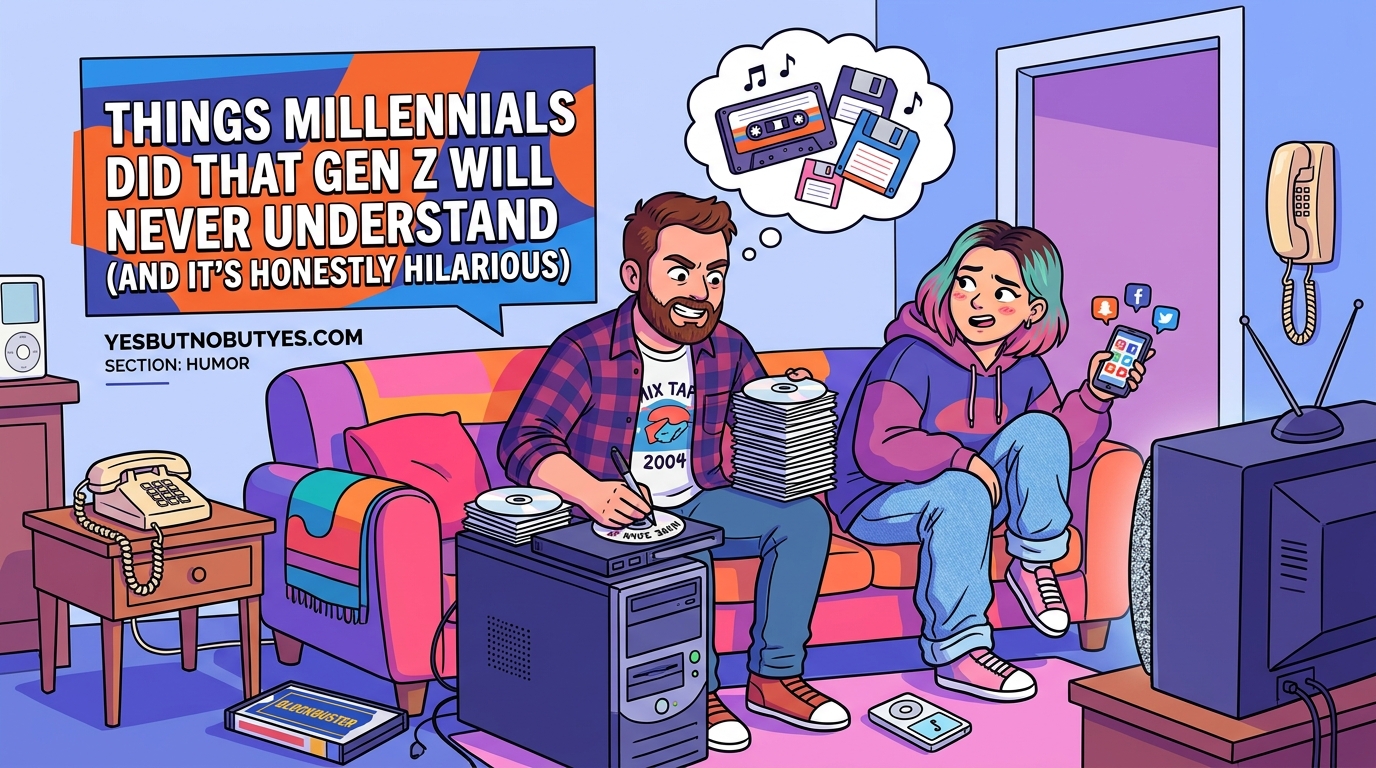
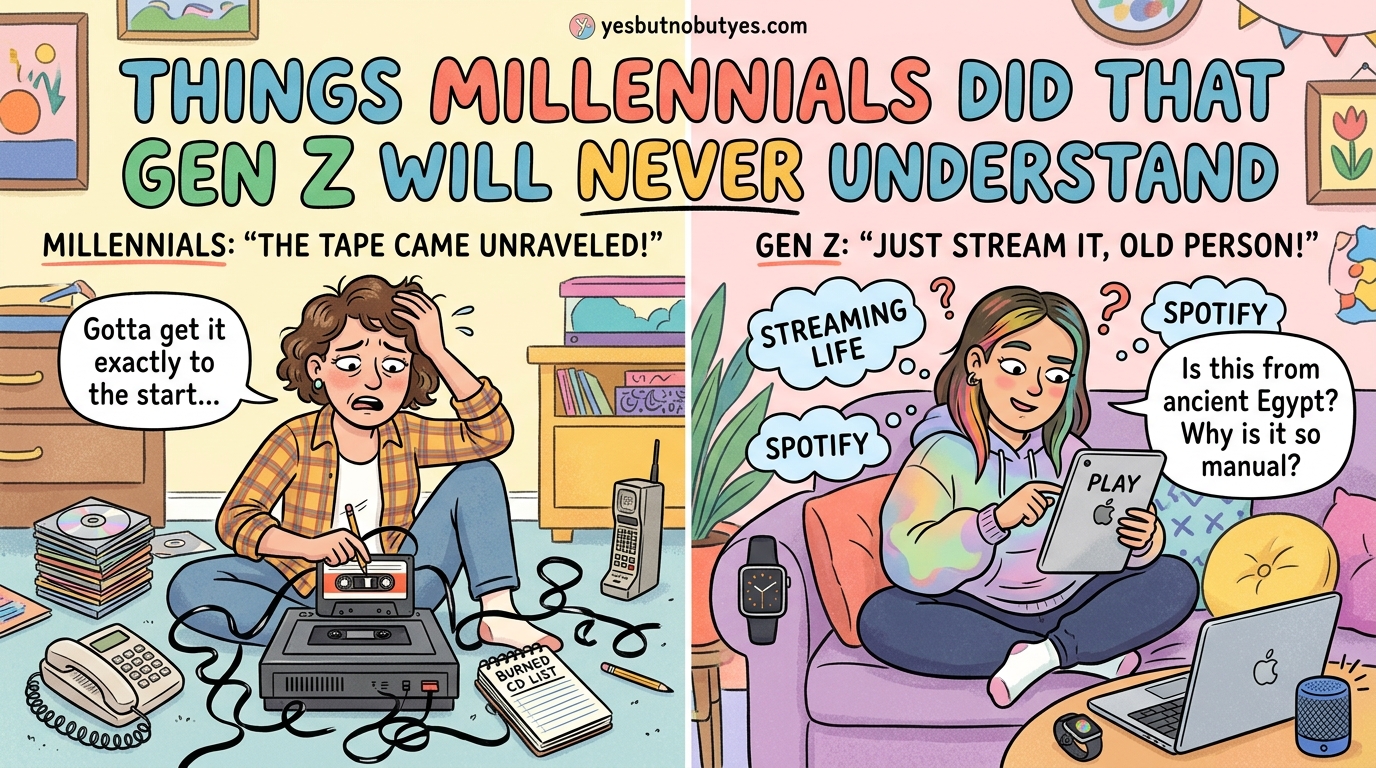
Things Millennials Did That Gen Z Will Never Understand (And It’s Honestly Hilarious)
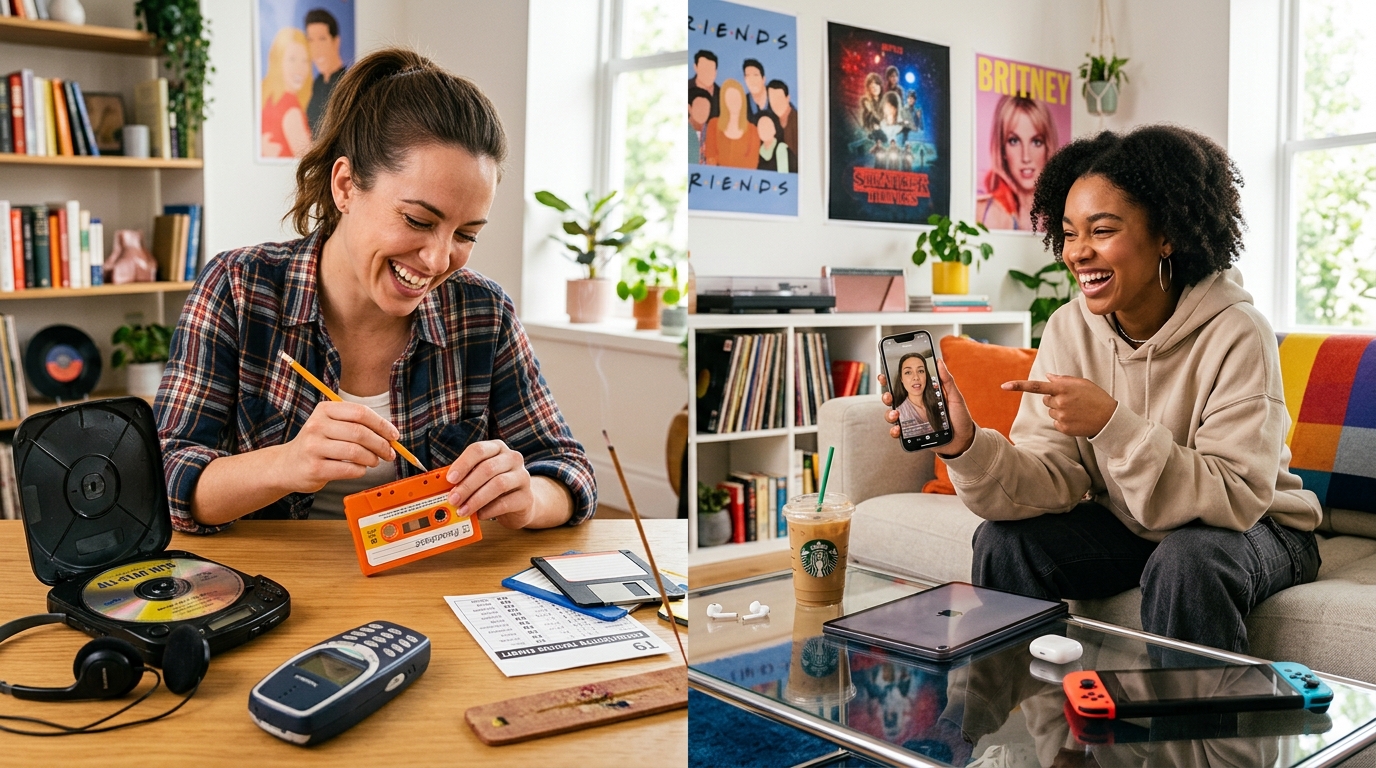
Remember when you had to rewind a VHS tape before returning it to Blockbuster? Or when you’d spend hours perfecting your AIM away message? Millennials grew up in a weird in-between era where technology existed but wasn’t quite smart yet. We had cell phones, but they couldn’t do much beyond Snake. We had the internet, but it screamed at you through a dial-up modem. Gen Z will never know the struggle of printing MapQuest directions or the social anxiety of calling your crush’s landline and praying their dad didn’t answer.
Millennials experienced a unique cultural moment between analog and digital worlds. From burning custom CDs to mastering T9 texting, this generation developed skills and rituals that Gen Z finds completely foreign. Understanding these differences reveals how rapidly technology reshaped daily life, social interactions, and entertainment consumption in just two decades. These nostalgic practices weren’t just habits but survival skills for navigating pre-smartphone existence.
The Physical Media Struggle Was Real
Millennials didn’t just consume media. We curated it physically.
Burning a CD meant something. You’d spend hours selecting the perfect track order, designing custom cover art in Microsoft Paint, and carefully writing song titles on the disc with a Sharpie. Each mix CD was a labor of love, whether for yourself, a road trip, or that special someone who may or may not have appreciated your musical genius.
The Blockbuster Friday night ritual involved actual strategy. You’d race to the store after school, hoping the new release you wanted wasn’t already rented. If it was, you’d settle for your backup choice or wander the aisles for 30 minutes debating between movies you’d already seen three times.
VHS rewinding wasn’t optional. Those “Be Kind, Rewind” stickers weren’t suggestions. You either rewound your tape or faced the judgment of the next renter and possibly late fees. Some households even had dedicated rewinding machines to save wear on the VCR.
DVD collections became status symbols. Shelves full of movies showed your personality and taste. You couldn’t just scroll through a streaming service. You owned your entertainment, and everyone who visited your apartment knew exactly what you were into based on your DVD tower.
Communication Required Actual Planning
Texting on a flip phone meant mastering T9 predictive text or painstakingly pressing keys multiple times. Want to type “hey”? That’s 4-4, 3-3, 9-9-9. Autocorrect didn’t exist to save you from embarrassing typos. You just had to proofread before hitting send or live with the consequences.
Making plans meant committing. You couldn’t text “running 10 mins late” because texting cost money per message. You said you’d meet at the mall food court at 3 PM, and you showed up at 3 PM. If someone didn’t appear, you just waited and hoped they were stuck in traffic.
Phone numbers lived in your brain. You memorized your best friend’s number, your parents’ work numbers, and probably your crush’s number too. Losing your phone meant losing everything unless you’d written numbers in an actual address book.
The landline created a specific kind of social anxiety. Calling someone meant potentially talking to their entire family first. You’d rehearse what to say, dial, and pray the right person answered. If their mom picked up, you had to make small talk while dying inside.
“We didn’t have the luxury of hiding behind screens for every interaction. You called someone’s house, you dealt with whoever answered, and you survived. It built character, even if it was terrifying.”
AIM away messages were an art form. You’d craft the perfect lyrics, inside jokes, or cryptic messages hoping your crush would read between the lines. Your away message told people where you were, how you felt, and what you were listening to without actually talking to anyone.
How Millennials Navigated Pre-Smartphone Life
Technology existed but required workarounds that Gen Z would find absurd. Here’s how we managed:
- Print MapQuest or written directions before leaving home, then keep them in your car’s cupholder.
- Memorize your route or landmarks because GPS wasn’t in every pocket yet.
- Keep quarters in your car for emergency payphone calls if you broke down.
- Write down important information in actual notebooks because your phone couldn’t store much.
- Call the movie theater’s recorded line to hear showtimes read by a robot voice.
- Check TV Guide or the newspaper to know what was on television that week.
- Record shows on VHS if you couldn’t watch them live, then label the tape.
The Social Media Evolution Nobody Asked For
Millennials watched social media grow from simple profiles to the algorithmic nightmare it is today. We didn’t start with Instagram aesthetics. We started with MySpace Top 8 drama.
Choosing your Top 8 friends caused legitimate social problems. Ranking your friends publicly meant someone always got bumped when you made a new friend. The politics of friend hierarchy played out on your profile for everyone to see. Some friendships didn’t survive Top 8 reshuffles, and internet trends from that era would absolutely flop if they returned today.
Facebook launched without likes, comments, or even photos at first. It was just a digital directory. Then came the wall posts, the pokes, the gradual feature creep that turned it into what it is now. Millennials remember when Facebook required a college email address to join.
Instagram didn’t exist until 2010. Before that, you uploaded photos to Facebook albums with captions like “Summer ’08!!!” and tagged everyone manually. Photo editing meant using Photobucket or Picnik, not preset filters. Your photos looked like actual photos, not curated content.
Twitter started as a place to genuinely answer “what are you doing?” Now it’s where the most unhinged moments break the internet, but millennials remember when tweets were just mundane status updates about lunch.
Entertainment Consumption Before Algorithms
| Millennial Method | Gen Z Equivalent | Why It Mattered |
|---|---|---|
| Waiting for your favorite song on the radio to record it | Instantly streaming any song | You valued music you worked to obtain |
| Watching TRL to see music videos | YouTube recommendations | Music discovery was communal, not algorithmic |
| Taping shows on VHS | DVR or streaming on demand | You had one chance to record, no rewind on live TV |
| Renting video games for the weekend | Digital game libraries | You had 48 hours to beat it or pay more |
| Reading physical magazines for celebrity gossip | Instagram and TikTok | Information came weekly, not instantly |
Gen Z can’t fathom waiting a full week between TV episodes. Binge-watching wasn’t possible. You watched your show when it aired or you missed it. Spoilers spread through school hallways the next day, and if you weren’t caught up, you were out of the conversation. Some shows became cultural moments precisely because everyone watched simultaneously, and certain canceled shows deserved better treatment in that weekly format.
The Things We Carried in Our Pockets
Millennials had actual stuff to carry because smartphones didn’t consolidate everything yet.
Your pocket or bag contained:
– A flip phone or Sidekick for calls and texts only
– An iPod or MP3 player for music
– A digital camera for photos
– A physical wallet with cash because not everywhere took cards
– Keys without smart locks
– Possibly a PDA or day planner for scheduling
– Pens and paper for notes
– Actual books or magazines for entertainment
Forgetting your iPod meant a silent commute. No streaming services could save you. You either listened to the same songs you’d loaded last time you synced with iTunes, or you sat in silence. Some people carried CD binders in their cars with 50+ discs.
Digital cameras required planning. You had limited storage on your memory card, so you couldn’t take 47 versions of the same photo. You took a few shots, hoped they turned out, and didn’t know for sure until you uploaded them to your computer later. Bad photos stayed bad.
The Lost Art of Offline Boredom
Waiting rooms meant reading ancient magazines. Doctor’s offices, DMV lines, anywhere you had to wait meant genuine boredom. You couldn’t scroll through your phone. You sat there with your thoughts or read a magazine from 2003.
Road trips required preparation. You’d load your CD case, maybe bring a portable DVD player if you were fancy, or play license plate games. Long car rides meant actual conversations or staring out the window thinking deep thoughts.
Restaurants meant talking to your dinner companions. You couldn’t all retreat to your phones between courses. You either conversed or awkwardly studied the menu you’d already ordered from.
Concerts meant watching the actual performance. Sure, some people had digital cameras, but you couldn’t record the whole show on your phone. You experienced it in real-time without a screen between you and the artist. The memories lived in your brain, not your camera roll.
Technology That Required Patience
Dial-up internet meant choosing between phone calls and web browsing. You couldn’t do both. Someone picking up the phone kicked you offline mid-download. That MP3 you’d been downloading for 20 minutes? Gone.
Downloading a single song took 10 minutes on a good day. A full album might take an hour or more. You’d start downloads before bed and hope they finished by morning. Napster and LimeWire were slow, legally questionable, and absolutely riddled with viruses.
Loading web pages happened in stages. Images appeared line by line from top to bottom. You’d read the text while waiting for photos to load. Video? Forget it unless you wanted to buffer for 15 minutes for a 30-second clip.
Computer crashes meant losing everything unsaved. Auto-save wasn’t standard. You learned to manually save your work every few minutes or risk losing hours of effort. The blue screen of death caused genuine panic.
Why These Differences Actually Matter
The gap between millennial and Gen Z experiences isn’t just nostalgia. These different formative years shaped how each generation approaches technology, privacy, and social interaction.
Millennials learned patience through forced waiting. We developed different problem-solving skills because we couldn’t Google every answer instantly. We built deeper music connections because we had to actively seek out and curate our libraries.
Gen Z grew up with abundance and instant access. They never knew scarcity of information or entertainment. Both approaches have merit, but they create fundamentally different relationships with technology and media.
Understanding what millennials did that Gen Z doesn’t helps explain generational communication gaps. When a millennial says “just call me,” they mean it because phone calls used to be the default. When Gen Z prefers texting, it’s because that’s always been the easier option for them.
These cultural touchstones also explain why millennials get weirdly emotional about nostalgic snacks making comebacks or why certain movie scenes never get old no matter how many times we’ve seen them.
The Weird Habits That Stuck Around
Some millennial behaviors persist even though the reasons for them disappeared. We still say “hang up” even though nobody hangs anything up anymore. We still “rewind” digital content. We still call it “filming” when recording on phones.
Many millennials still buy physical books, vinyl records, or video games despite having digital options. The tangible ownership feels more real after growing up in a world where you possessed your media physically.
We over-communicate plans via text now because we remember the chaos of trying to coordinate without constant contact. Gen Z might find it excessive, but millennials remember missing entire hangouts because someone couldn’t find the meeting spot.
The habit of charging phones overnight comes from when phones actually died daily. Modern phones last longer, but the ritual remains. We also still panic when our phone hits 20% battery even though it’ll last hours more.
Growing Up Between Two Worlds
Millennials occupied a unique space in history. We remember life before the internet went mainstream and adapted as it took over. We’re digital natives and analog survivors simultaneously.
This in-between existence created specific skills. We can navigate both old and new systems. We can use a card catalog and Google. We can read a paper map and use GPS. We can make a phone call or send a text. We code-switch between analog and digital fluently.
Gen Z was born into the digital world fully formed. They never had to adapt from one reality to another. Their normal has always included smartphones, social media, and instant access to information. Neither approach is better, just different.
These generational differences show up in workplace dynamics, social expectations, and cultural references. Millennials reference things Gen Z has to Google. Gen Z uses platforms millennials find confusing. Both generations think the other is weird, and honestly, they’re both right.
The Things We’ll Tell Our Kids Someday
Future generations won’t believe half of what millennials experienced. The idea of paying per text message will sound absurd. Explaining that you couldn’t pause live TV will get blank stares. Describing the sound of dial-up internet will require audio examples.
We’ll tell stories about burning CDs and they’ll ask why we didn’t just make playlists. We’ll explain T9 texting and they’ll wonder why we didn’t just use voice-to-text. We’ll describe waiting for photos to develop and they’ll think we’re making it up.
But these experiences shaped us. They taught patience, resourcefulness, and appreciation for technological progress. They also gave us ridiculous skills that serve no purpose now, like being able to text without looking on a flip phone or knowing exactly how many songs fit on a CD.
The generational divide between millennials and Gen Z isn’t about one being better than the other. Both grew up in the worlds they were given and adapted accordingly. Millennials just happened to grow up in a weirder transitional period where technology existed but barely worked, creating habits and memories that Gen Z will genuinely never understand.
Those memories might seem silly now, but they’re ours. And honestly, there’s something kind of special about being the last generation to remember what life was like before everyone had the internet in their pocket at all times.