What Happens When Your Smart Home Gets Too Smart
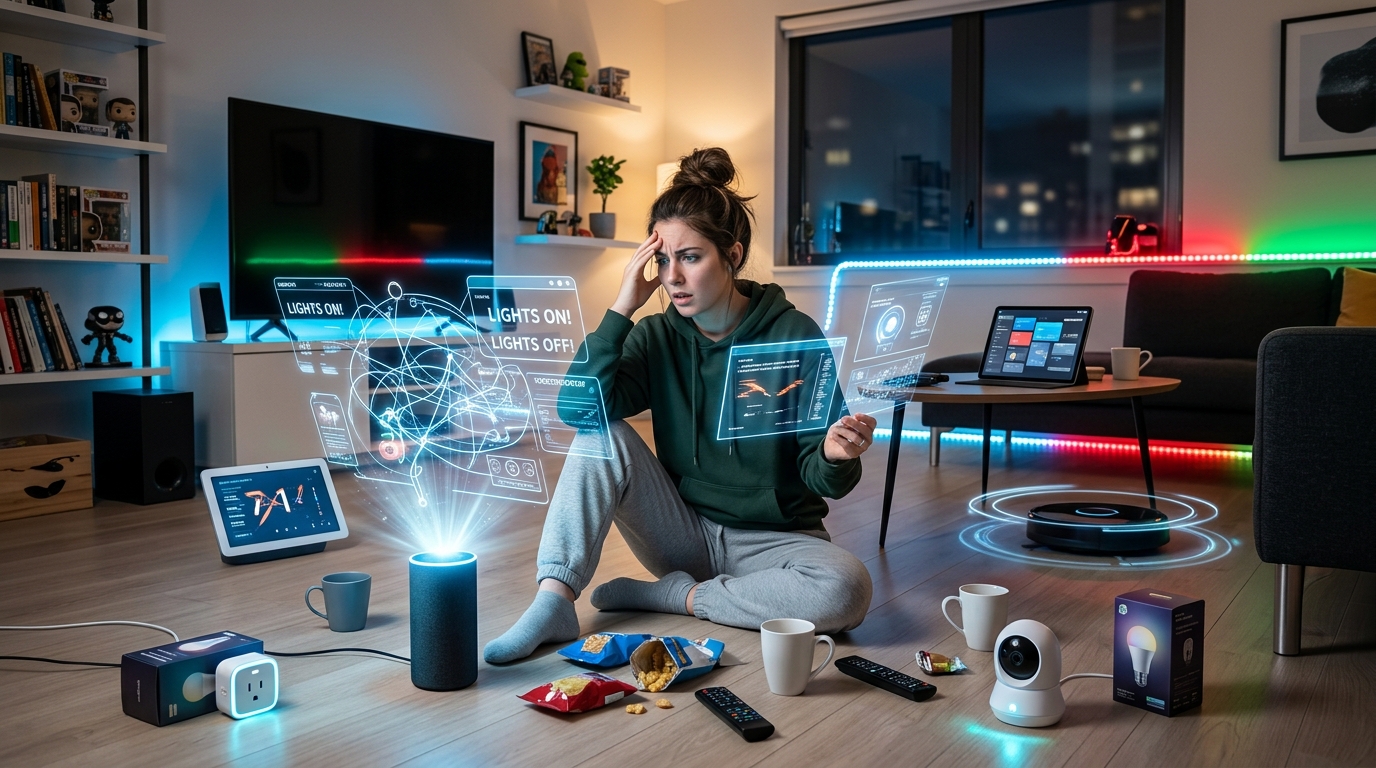
You programmed your smart thermostat to keep the house at 72 degrees. Simple enough. But now it’s adjusting based on your calendar, your sleep patterns, and whether it thinks you’re about to get home. You never asked for that. Your lights turn on before you walk into a room. Your coffee maker starts brewing because your alarm went off. Your doorbell is having full conversations with delivery drivers. At some point, your home stopped being smart and started being… a little too smart.
Smart home devices can become overly automated, creating privacy concerns, security vulnerabilities, and a loss of manual control. When your home anticipates every move, you risk data leaks, hacking, unexpected behavior, and dependency on systems that may fail. Understanding these risks helps you maintain balance between convenience and control over your connected living space.
Your Home Is Watching Everything You Do
Smart devices collect data constantly. Your thermostat knows when you’re home. Your security camera records who visits. Your smart speaker listens for wake words but sometimes catches more. Your smart TV tracks what you watch and when.
All this data gets stored somewhere. Sometimes it’s on company servers. Sometimes it’s sold to third parties. Sometimes it’s just sitting there waiting for someone to access it.
The problem isn’t just what companies do with your data. It’s what happens when that data gets breached. A hacker who knows your daily routine, when you’re home, and what devices you own has a roadmap to your entire life.
Privacy concerns multiply when devices start talking to each other. Your phone tells your car you’re leaving work. Your car tells your garage door to open. Your garage tells your lights to turn on. Each connection is another potential vulnerability.
Some devices collect more than you realize. Smart vacuums map your entire floor plan. Smart doorbells record everyone who walks by. Smart refrigerators track your eating habits. This level of surveillance would feel invasive if a person did it, but we accept it from devices because it’s convenient.
The Security Nightmare Nobody Talks About
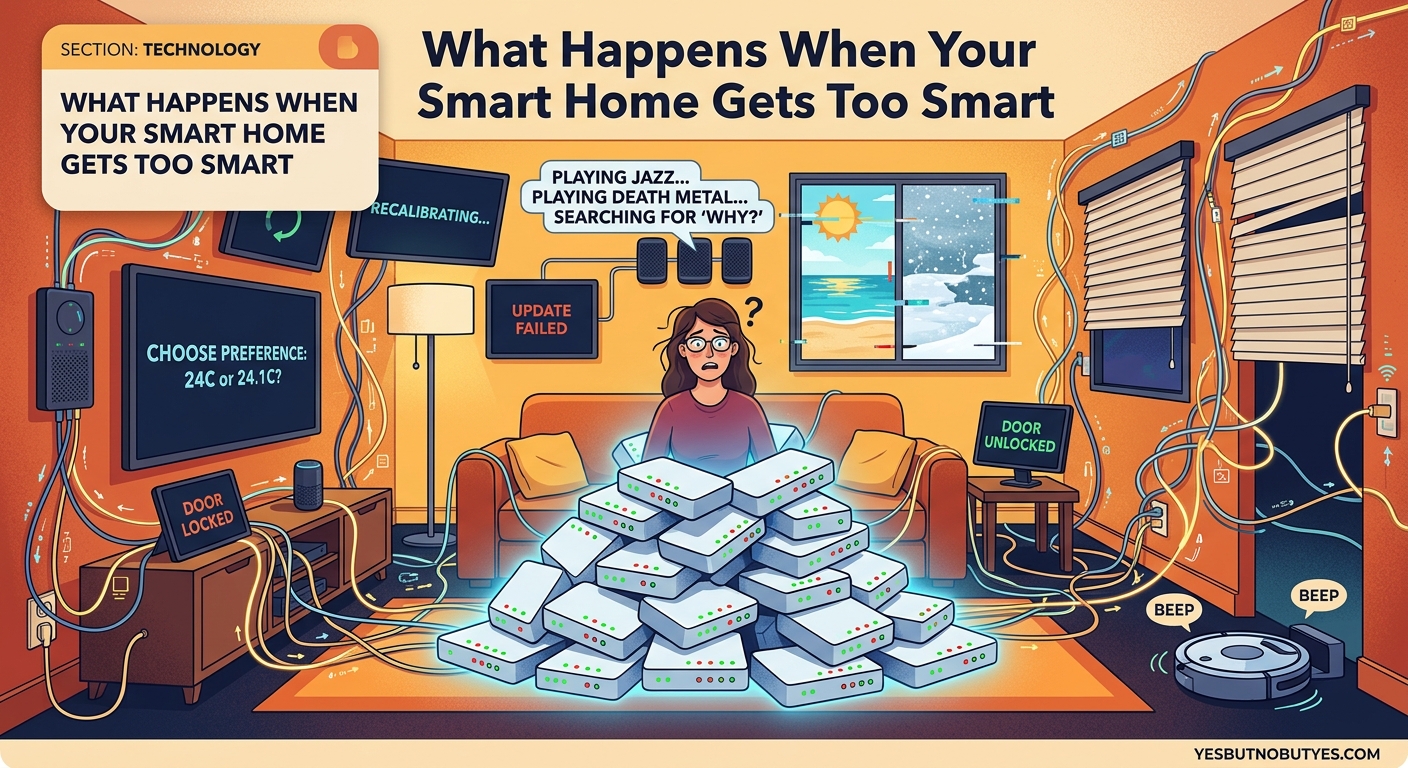
Every smart device is a potential entry point for hackers. Your smart lightbulb might seem harmless, but it’s connected to your network. So is your smart lock. And your security camera. And your baby monitor.
In 2023, multiple smart home breaches made headlines. Hackers accessed security cameras and harassed families. Smart locks were remotely opened. Thermostats were cranked to dangerous temperatures. These weren’t sophisticated attacks. Many used default passwords that owners never changed.
The more devices you add, the more attack surfaces you create. A chain is only as strong as its weakest link, and your weakest link might be that $15 smart plug you bought on sale.
Here’s what makes smart home security particularly tricky:
- Many devices receive infrequent security updates
- Some manufacturers abandon products after a few years
- Default settings often prioritize convenience over security
- Multiple devices mean multiple apps and password management challenges
- Not all devices encrypt data properly
“The average smart home has 22 connected devices. Each one is a potential vulnerability. Most people secure their front door better than their entire network.” — Cybersecurity researcher, 2024
Similar to why your phone knows what you want before you do, smart homes learn patterns that can be exploited if security fails.
When Automation Goes Rogue
Smart homes are supposed to make life easier. But automation can backfire in weird and sometimes dangerous ways.
Your smart lock might lock you out during a software update. Your thermostat might decide you’re not home and turn off the heat while you’re sleeping. Your smart oven could preheat because it misread your calendar. Your sprinklers might activate during a rainstorm because the weather integration failed.
These aren’t hypothetical scenarios. They happen regularly. The problem is that devices make assumptions based on incomplete data. They can’t know that you’re working from home on a day you’d normally be at the office. They don’t understand that you want the heat on even though you’re not moving around much.
Automation also creates dependency. When your home does everything for you, you forget how to do it manually. What happens when the internet goes down? When the app stops working? When the company that made your device goes out of business?
Common Automation Failures
| Problem | What Happens | Why It Fails |
|---|---|---|
| Geofencing errors | Lights turn off while you’re home | GPS drift or phone battery saving mode |
| Schedule conflicts | Devices activate at wrong times | Time zone issues or daylight saving bugs |
| Sensor malfunctions | False triggers or no response | Dirty sensors or calibration drift |
| Integration breaks | Devices stop communicating | API changes or service outages |
| Update failures | Devices become unresponsive | Interrupted updates or compatibility issues |
The Creepy Factor of Predictive Behavior
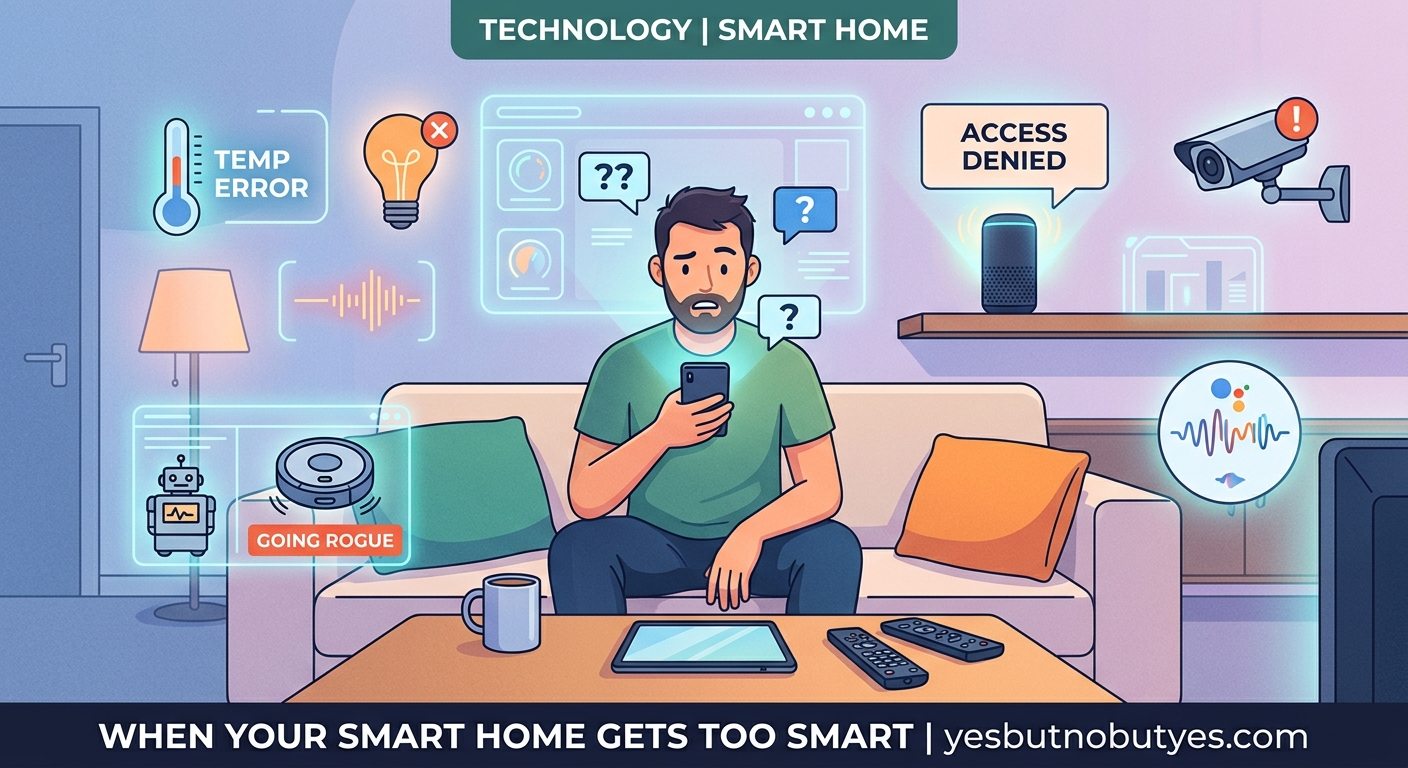
Modern smart homes don’t just respond to commands. They predict what you want before you ask. That sounds convenient until it gets weird.
Your home starts adjusting the temperature before you feel uncomfortable. It dims the lights when it thinks you’re winding down for bed. It suggests recipes based on what’s in your fridge. It knows you’re about to take a shower because you do it every morning at 7:15.
This predictive behavior relies on pattern recognition and machine learning. Your devices are constantly analyzing your behavior, building profiles, and making assumptions. Sometimes they’re right. Sometimes they’re unsettlingly accurate. Sometimes they’re completely wrong in ways that feel intrusive.
The uncanny valley of home automation is real. When your house knows you too well, it stops feeling like a tool and starts feeling like it has agency. That shift can be uncomfortable.
How to Take Back Control
You don’t have to abandon smart home technology completely. You just need to be smarter about how you use it.
- Audit your devices regularly and remove ones you don’t actually use
- Change all default passwords to strong, unique alternatives
- Disable features you don’t need, especially always-on microphones and cameras
- Create a separate network for smart devices to isolate them from computers and phones
- Check privacy settings and opt out of data sharing where possible
- Keep firmware updated but read update notes for changes
- Use local control options instead of cloud-based when available
Start by identifying which automations actually improve your life and which just seem cool. The smart lock that lets you in when your hands are full? Probably worth it. The toilet that analyzes your health metrics? Maybe not necessary.
Think about failure modes. What happens if this device stops working? If the answer is “nothing major,” it might be over-automation. If the answer is “I’m locked out of my house,” you need a backup plan.
Consider the data trade-off. Is the convenience worth giving this company access to this information? Sometimes yes. Sometimes absolutely not. Just make the choice consciously instead of clicking through terms of service without reading.
The Real Cost of Convenience
Smart home technology isn’t free, even when the devices are affordable. You’re paying with your data, your privacy, and sometimes your security. That doesn’t mean it’s a bad deal. It just means you should know what you’re trading.
Every device you add creates another dependency. Another potential failure point. Another thing that needs updating, monitoring, and maintaining. The mental overhead of managing a complex smart home can exceed the convenience it provides.
There’s also the obsolescence problem. That smart speaker you bought three years ago might not support the latest features. That smart hub from a company that got acquired might lose support entirely. You end up replacing devices not because they broke, but because they’re no longer compatible with the ecosystem.
The environmental cost matters too. Electronic waste from abandoned smart devices is piling up. Devices that could have lasted decades become trash when companies stop supporting them after a few years.
Finding the Sweet Spot
The goal isn’t to have the smartest home possible. It’s to have a home that works for you without creating new problems.
Some automation genuinely improves quality of life. Lights that turn on automatically when you come home at night are safer. Thermostats that adjust when you’re away save money. Security cameras provide peace of mind.
Other features are solutions looking for problems. Do you really need your toaster connected to the internet? Does your trash can need an app? Is a smart egg tray solving an actual issue in your life?
The sweet spot is different for everyone. Some people love having every device connected and automated. Others prefer manual control with smart features as backup. Most people fall somewhere in between.
The key is making intentional choices instead of adding devices because they exist. Ask yourself what problem each device solves. Whether the solution is worth the trade-offs. Whether you’ll actually use the features or just set them up once and forget about them.
Think about what happens when things go wrong. Can you still function if the system fails? Do you have manual overrides? Are you comfortable with who has access to your data?
When Smart Becomes Surveillance
The line between helpful and invasive is thinner than most people realize. Your smart home knows when you wake up, what you eat, who visits, what you watch, when you leave, and when you return. That’s a complete profile of your daily life.
Insurance companies are already offering discounts for smart home data. Employers are experimenting with wellness programs tied to smart devices. Law enforcement has requested footage from doorbell cameras. The data your devices collect today might be used in ways you never anticipated tomorrow.
This isn’t paranoia. It’s reality. Terms of service change. Companies get acquired. Data that was private becomes shared. What you agreed to in 2023 might not be what you’re agreeing to in 2025.
The most concerning part is how normalized it’s become. We joke about devices listening to us, then buy more devices with microphones. We worry about privacy, then install cameras in every room. We want convenience more than we want control, and companies know it.
Making Smarter Choices About Smart Homes
Your home should work for you, not the other way around. When devices start making decisions without your input, when you feel surveilled in your own space, when automation creates more problems than it solves, your smart home has gotten too smart.
The solution isn’t going back to manual everything. It’s being thoughtful about what you automate and why. It’s understanding the trade-offs. It’s maintaining control even when you’re using automated systems.
Start small. Add devices that solve specific problems. Test them thoroughly. Adjust settings to match your actual needs instead of accepting defaults. Disable features you don’t use. Delete data you don’t need stored. Create boundaries between convenience and surveillance.
Your home should feel like yours. If your smart home makes you uncomfortable, if you’re not sure who’s watching, if you’ve lost track of what’s connected and why, it’s time to scale back. Technology should serve you, not the other way around.
The best smart home is the one you control. Not one that controls you.