GTA 6 Hype Has Officially Jumped From Gamers to the Entire Internet
There’s a game that hasn’t been released yet. No one has played it. No one has seen more than a couple of trailers. And yet somehow, it’s the thing everybody on the internet is talking about. Not just gamers. Not just tech bros. Everybody. Your aunt who uses Facebook to post inspirational quotes. The girl in your office who thinks Minecraft is called “the block game.” The guy at the coffee shop who claims he doesn’t own a television. GTA 6 has officially escaped the gaming world, and at this point, it’s less of a product launch and more of a shared cultural hallucination.
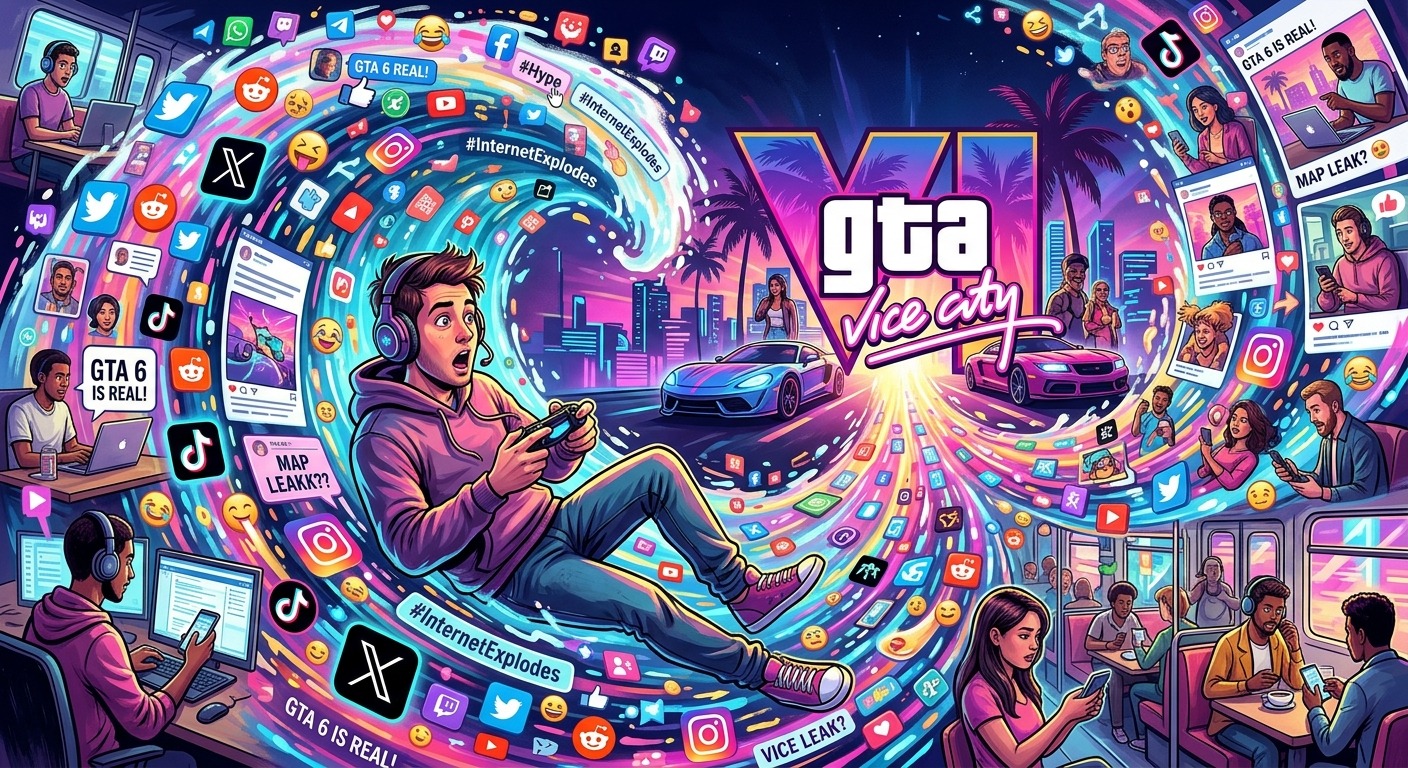
The GTA 6 hype cycle is no longer about gaming. It’s a full-blown internet personality trait.
- People who have never played a GTA game are obsessively tracking the release date across TikTok, Reddit, and Discord servers they joined specifically for this purpose.
- The “GTA 6 wait” has become its own content micro-genre, racking up tens of millions of views from audiences with zero gaming background.
- The hype cycle itself has become more entertaining than most actual games that have launched in the past two years.
How a Video Game Nobody Can Play Yet Took Over the Whole Internet
GTA 6 was officially announced by Rockstar Games in December 2023, dropping a trailer that broke YouTube records and practically crashed the internet for a full afternoon. The clip hit 93 million views in its first 24 hours. The game has been in development for so long that its full production timeline reads like a documentary arc, spanning over a decade of work and speculation. But that raw number is the part that matters here. 93 million views in a single day isn’t gamer behavior. That’s the whole internet showing up at once.
And it didn’t stop there. That moment lit a fuse that has been burning ever since. Every week there’s a new leak. Every month there’s a new rumor. Every few weeks someone on Reddit posts what appears to be internal Rockstar footage, a screenshot, or a gameplay clip, and the entire internet loses its mind for 48 hours before it gets debunked. It’s become a ritual at this point. And that ritual has pulled in people who couldn’t name a single character from the previous games if their life depended on it.
TikTok Turned the Wait Into a Genre of Its Own
TikTok is where the non-gamer conversion actually happens. If you spend any time on that app, you’ve seen the videos. Someone makes a “things I’ll do before GTA 6 drops” list. Someone else posts a skit about turning 40 by the time it finally releases. A third person creates a heavily edited montage of the trailer set to whatever trending audio is making the rounds that week. These videos collect millions of views from people who are in on the joke without being in on the game at all.
The content isn’t really about GTA 6. It’s about the wait itself. The wait has become the product. It’s like the game has spawned its own separate entertainment ecosystem, and that ecosystem runs entirely on anticipation, collective impatience, and a shared understanding that this is taking a genuinely absurd amount of time.
What makes it so TikTok-compatible is the self-aware humor. The best-performing videos in this space don’t explain the game. They don’t feature gameplay analysis or lore deep-dives. They’re just people being extremely online about the fact that a game exists and isn’t out yet. That’s content anyone can participate in. You don’t need to know what Liberty City is. You just need to know that everyone is waiting and that everyone finds that funny.
What the Hype Cycle Actually Looks Like, Step by Step
For anyone who wandered into this cultural moment without a gaming background, here’s how the cycle tends to move. It’s a fairly predictable loop at this point, and once you see it, you cannot unsee it.
- A leak surfaces. It’s usually a blurry screenshot, a supposed audio clip, or a Reddit thread claiming inside information. The post gets tens of thousands of upvotes within hours of appearing.
- The internet debates it. Half the comments call it fake. Half call it real. Both sides are extraordinarily passionate about a game none of them have played.
- A content creator covers it. A YouTube video or TikTok gets made about the leak within hours. This video reaches people who have never visited a gaming forum in their life.
- The mainstream picks it up. Someone screenshots the TikTok and posts it elsewhere. A meme account reposts it. The conversation has now officially left the gaming world entirely and entered general internet discourse.
- It gets debunked or quietly fades. The cycle resets. Everyone waits for the next leak. Nobody loses interest. The whole thing starts again.
This loop has been running consistently for well over a year now. It’s remarkably durable. And every pass through the cycle drags in another wave of people who had no prior connection to the franchise.
The Part Where I Admit I’m Fully One of These People
I should be upfront. I am writing this article as someone who has not played GTA 5 in any meaningful way. I have picked up a controller exactly once, driven a virtual car extremely badly, and put it back down within fifteen minutes. That is the full extent of my relationship with this franchise. And yet I’ve had GTA 6 news bookmarked since last year and I don’t even play video games, which is a sentence I never thought I’d type.
That’s the thing about this particular hype cycle. It has recruited people like me. People who are not the target audience by any reasonable definition. People who are here purely because the cultural noise around this game has gotten loud enough that ignoring it feels like missing something important. That’s a very different motivation from wanting to play a video game. That’s fear of missing out applied to a product you don’t actually want to own.
Researchers sometimes call this kind of behavior parasocial consumption, where people invest genuine emotional energy into something without direct participation. You don’t need to buy the thing. You just need to track it, talk about it, and feel like you’re part of the conversation. GTA 6 has become a masterclass in triggering that response at enormous scale, and it didn’t even have to try.
Why GTA 6 Crossed Over When Other Games Didn’t
There have been other massive game releases in recent years. Some of them broke records. Some of them generated serious buzz. None of them pulled in non-players quite the way GTA 6 anticipation has. A few specific ingredients made this one different from everything else in the gaming calendar.
- The gap is genuinely absurd. GTA 5 came out in 2013. The sequel has been in development for over a decade. Things that wait that long take on mythological status, and mythology attracts audiences who were never originally invested in the source material.
- The trailer looked like a film, not a game. It wasn’t confusing gameplay footage filled with UI elements and skill trees. It was cinematic in a way that non-gamers could immediately appreciate. That visual accessibility is rare for a gaming trailer and it matters enormously for crossover reach.
- The setting was instantly meme-able. The Florida backdrop, the characters, the entire vibe translated into internet humor within hours of the trailer dropping. Meme-ability is a crossover superpower that most games simply don’t have.
- The brand already had name recognition outside gaming. GTA is one of the handful of gaming franchises that people know even if they’ve never touched a controller. That pre-existing cultural awareness made the announcement land with far more weight than it would for an unknown property.
Being Chronically Online Has Found Its Perfect Obsession
There’s a specific kind of internet personality that thrives on countdown culture. The person who is always tracking what’s next. Who maintains a running mental list of anticipated releases, announcements, and cultural events. Who finds genuine satisfaction in the pre-release phase of anything, whether it’s a TV show, a sneaker drop, or a video game. For that type of person, GTA 6 is an almost perfectly engineered object of fixation.
It has been anticipated long enough to build real mythology. It has a clear eventual endpoint. It generates fresh content constantly without actually arriving. And the audience has grown so large and so diverse that participating in the wait is its own form of social currency. You can post about it and be understood by almost anyone who spends meaningful time online. That’s genuinely rare for a gaming product, and it’s exactly what pushed this story from a gaming conversation into a full cultural one.
The hype has also spawned a dense layer of meta-humor that runs independent of any actual gaming interest. Memes about people who were teenagers when GTA 5 came out now being adults with careers, mortgages, and children, still waiting for the sequel. Content about everything a person could have accomplished during the years since the last entry. Ironic timelines that calculate how old you’ll be when the game actually ships. This content performs because it’s relatable, not because the audience wants to play. The wait is the joke. Everyone is in on it. The game is almost secondary.
What Happens to All That Collective Energy When It Finally Drops
Rockstar didn’t engineer a marketing strategy designed to capture non-gamers. They made a game that took a very long time, built massive goodwill over a decade, and then dropped a trailer so visually compelling that the algorithm did the rest. The meme ecosystem, the TikTok pipeline, the crossover appeal of cinematic footage, the sheer scale of the delay, all of it combined to create a cultural moment that no marketing budget could have intentionally manufactured.
That’s genuinely worth paying attention to. The GTA 6 hype cycle has become an accidental case study in how the internet transforms almost anything into a shared cultural experience when the right conditions collide. You need a recognizable name. You need something worth anticipating. You need a delay long enough to build mythology. And you need a visual identity that translates instantly into memes. Satisfy all four conditions and suddenly the whole internet is waiting for your thing, whether they originally cared or not.
By the time the game actually releases, a significant chunk of the people who were loudest about the wait probably won’t buy it. They weren’t waiting to play. They were waiting to be part of the conversation. And in this era of chronically online behavior, that’s a completely valid way to engage with culture. The hype was real. The investment of attention was real. The game was almost beside the point.
What happens to all that collective energy the morning after launch is the question nobody is really asking yet. The countdown ends. The meme cycle shifts. The internet finds its next obsession. The cycle doesn’t really close. It just relocates. But for now, in this strange in-between space before release, GTA 6 is doing something genuinely rare. It has turned waiting into a hobby, and recruited an entire internet’s worth of people who never once asked to care about a video game.