How Pop Lyrics Became the Internet’s Favorite Way to Feel Seen
My Instagram bio has changed approximately eight times in the last two years. Every single version was a song lyric. A couple were Sabrina Carpenter. One was Chappell Roan. There was a brief Taylor Swift era I am not going to address directly. Friends texted asking if I was okay. I was fine. I was just really, really into whatever was dominating the charts that week and apparently needed everyone to know it.
That is the thing about pop music and the internet right now. The two have fused into something neither fully anticipated. Song lyrics are no longer just something you know by heart because you heard them on the radio for four months straight. They are emotional infrastructure. They are how chronically online people communicate feelings they cannot quite name on their own, and also how they perform those feelings for an audience of three hundred followers who may or may not be paying attention.
The Lyric Feeling
Pop music has always been emotional shorthand, but the internet turbocharged it. A single line from Sabrina Carpenter or Chappell Roan now travels faster than any think piece, landing in Instagram bios, TikTok captions, and group chats within hours of a song dropping. It connects people who have never met through the shared recognition of a feeling they could not quite put into words on their own.
The Instagram Bio Has Become a Mood Board in Text Form
There was a moment when Instagram bios were actual descriptions of a person. “Foodie. Dog mom. Wanderlust.” Honestly humiliating in retrospect, but at least honest. Now the bio functions more like a gallery installation. Specifically, a gallery installation where every piece on the wall is a lyric from whoever you are currently listening to on repeat at 11 p.m.
The “era” framework has taken over every corner of the internet. You are not just going through a breakup. You are in your heartbreak era, and your bio had better signal that loud and clear. Right now that means a line from Sabrina Carpenter’s latest album. Three months ago it was Chappell Roan. Next month it will be whoever just dropped something that sounds exactly like your current situationship energy.
This is not random. The whole category of pop lyrics has effectively been engineered to hit the intersection of hyper-specific and universally relatable. A lyric lands because it feels like it was written about your exact circumstances, even though seventeen million other people had the exact same reaction at the exact same moment. That tension is the whole magic trick. Songwriters who crack it become quotable at internet speed.
TikTok Captions and the Art of Saying Everything With Sixteen Words
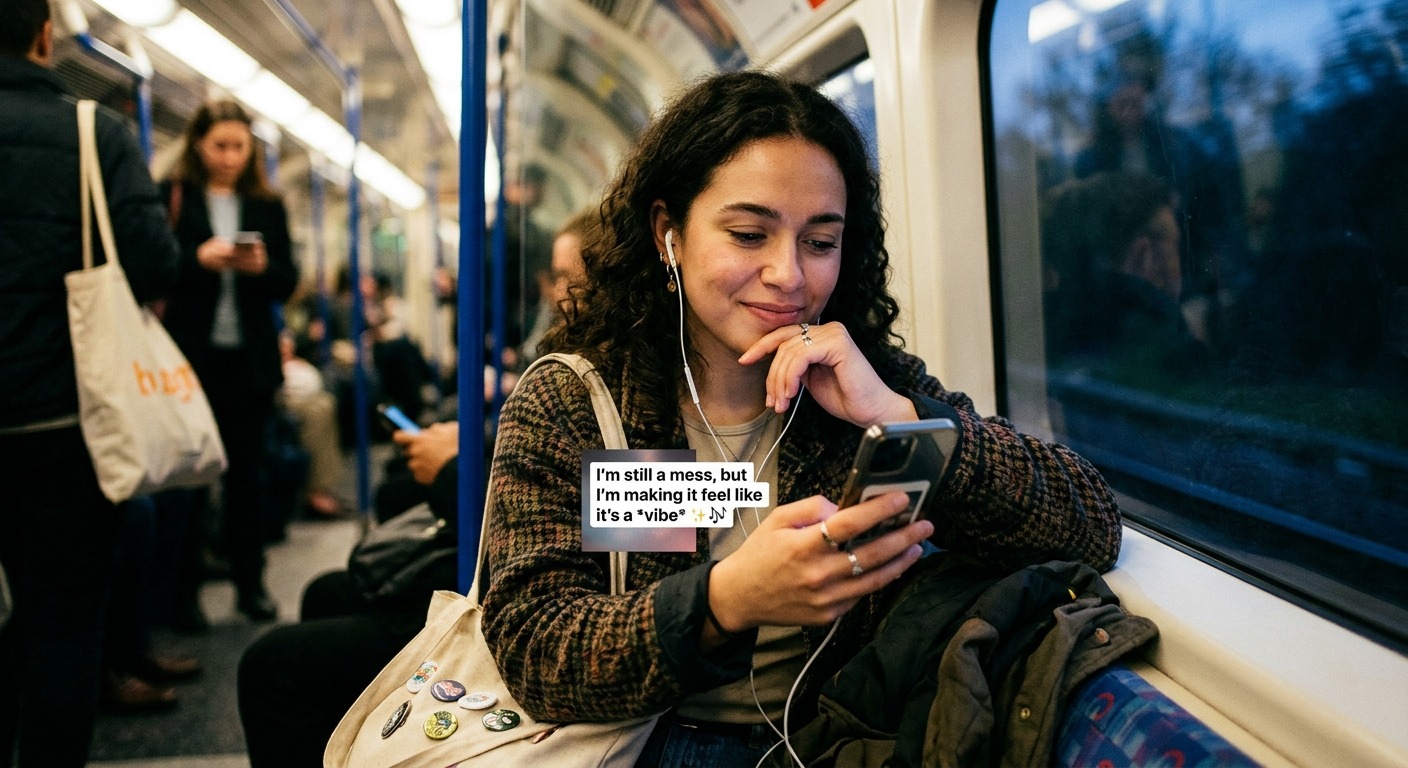
TikTok turned the lyric-as-caption into a full-on genre. The formula is consistent enough to have become almost ritualistic. A video of someone doing something mundane. A trending sound underneath it. A lyric stitched into the caption or overlaid on the clip that reframes the mundane as something loaded with meaning.
You are not just making coffee. You are making coffee “after everything.” You are not just sitting in your car before going inside. You are sitting in your car, Chappell Roan is playing, the light is catching the windshield just right, and the caption tells everyone you are very much feeling some feelings right now. The video has three hundred thousand views. Nobody needed to know what you were actually thinking. They just needed the right lyric dropped in the right place at the right moment.
The genius of this format is that the lyric does the emotional heavy lifting. You do not have to explain yourself. You pick sixteen words from someone better at articulating your inner life than you are, post them next to your face, and suddenly the comment section fills with “okay this is literally me” and people tagging their best friends. Connection established. No direct vulnerability required beyond choosing the right song.
Sabrina Carpenter has become a particular master of the quotable line. Her lyrics are short, punchy, and laced with enough self-aware wit that they read as both sincere and slightly ironic. That dual register is exactly what this generation wants from a caption. You can quote her and mean it completely. You can quote her as a bit. The whole point is that nobody has to know which one you are doing.
Chappell Roan and the Feeling of Being Understood at Scale
Chappell Roan’s rise is the clearest example of what happens when lyrics function as communal shorthand rather than just personal favorites. Her music does not describe ordinary life exactly. It describes theatrical, operatic, larger-than-life versions of feelings. And somehow that is precisely what connected with people who spend most of their day scrolling through other people’s emotional highlight reels.
“Pink Pony Club” became a caption. “Good Luck, Babe!” became a text sent to a situationship after things went sideways. “Femininomenon” became a bio choice for the days you were feeling yourself and needed the world to clock it immediately. The songs work as personal experiences and as collective language at exactly the same time. That is a hard thing to engineer, and she did it repeatedly.
That scalability is genuinely new. Lyrics used to go communal through radio singalongs or stadium shows. Now they spread instantly, without requiring anyone to be in the same room or even the same time zone. You post a lyric, someone two thousand miles away reposts it, and suddenly a feeling has been collectively agreed upon by strangers who will never meet. There is something oddly comforting about that, even if it is also a little strange to examine too closely.
The Many Ways a Lyric Shows Up in Your Feed Before Noon
The usage patterns have multiplied to the point where you can map a single popular lyric across half a dozen different formats in one morning of scrolling. Here is roughly how it moves once a song makes contact with the algorithm:
- The Instagram bio: Updated within 48 hours of an album drop, usually the line that hit hardest on the first listen through.
- The TikTok caption: Paired with a trending audio clip, repurposed to make a mundane moment feel cinematic or devastating, sometimes both at once.
- The group chat screenshot: Sent without context, followed by “this one,” which everyone in the chat immediately understands without further explanation needed.
- The tweet or thread opener: Used to set a tone before someone unpacks a feeling in 280 characters, or a longer thread they definitely should not have posted at midnight.
- The Discord status: The most niche deployment but also somehow the most committed one.
None of this is coordinated. It just happens because the lyric resonated, and people who resonate with the same thing tend to use it the same way. That is word-of-mouth at digital scale, and pop music figured out how to ride it better than almost any other medium currently alive.
Why a Song Line Lands Harder Than a Journal Entry
There is actual psychology behind why this works so consistently. Music and emotional processing are deeply linked in the brain. Studies catalogued in music cognition research show that emotionally resonant music activates reward pathways and triggers autobiographical memories in ways that few other stimuli can match. Lyrics give people language for internal states they cannot independently access. A line you could never have written yourself still feels like it came from somewhere deep inside you the moment you hear it.
Pop lyrics in particular are optimized for this effect. They are short. They are rhythmically satisfying. They describe something emotionally recognizable without narrowing it so specifically that it excludes anyone. The specificity that does exist is calibrated to make listeners feel seen rather than left out. Writing a lyric that does all of that cleanly is a real craft, and the artists who crack it become quotable at a speed no previous era of popular music could match.
The result is that a lyric functions almost like a mood tag. You do not have to explain your emotional state in your own imprecise words. You just cite the person who already said it better. It is outsourcing your inner monologue to someone with a better vocabulary and a production budget. Slightly lazy, honestly very effective.
The Hidden Social Math of Lyric Posting
There is a social function here worth naming. Quoting a lyric is low-risk emotional disclosure. It lets you say something real about your internal state while maintaining a layer of distance. If anyone asks, you can say you just liked the song. The lyric does the confession for you while you stand slightly behind it, technically deniable and emotionally present at the same time.
That combination of authenticity and plausible deniability is very on-brand for how chronically online people navigate self-expression. You want to be seen. You also do not want to be seen wanting to be seen. A well-chosen lyric threads that needle in a way that a direct statement rarely does. Here is how a line tends to travel from new release all the way to cultural shorthand:
- An artist releases a track with a line that hits an unusually specific emotional nerve.
- Early listeners post it as a caption within hours, usually on TikTok or X.
- The audio becomes a trending sound, and the lyric gets attached to dozens of different video formats.
- It migrates to Instagram bios, Discord statuses, and group chat screenshots simultaneously.
- It reaches peak saturation when people who have not heard the full song are already using the lyric freely.
- Someone makes fun of its overuse, which paradoxically extends its cultural life by several additional weeks.
- It settles into the collective lexicon as something everyone understands without needing to trace back to its source.
Chappell Roan went through that full cycle with multiple songs in the span of about eighteen months. Sabrina Carpenter is currently somewhere in the middle of it with at least two different lyrics from her recent work. The cycle is getting faster every year, which means the turnover in bios and captions is accelerating too. New era. New lyric. Same fundamental human need to feel understood by people you have mostly never met.
Still Quoting, Still Not Fully Sorry About It
My bio currently has a lyric from an artist I will not name here, because by the time you read this I have probably already changed it again. That is the honest reality of using pop lyrics as emotional signposts. The songs rotate. The feelings stay roughly the same. The format just happens to be very convenient for someone who has a lot of feelings and a limited number of words to describe them with.
The deeper thing is that it actually works. Not just as a performance for an audience, but as a genuine way of processing something. Finding the lyric that names the feeling is part of dealing with the feeling. It is imprecise therapy, but it is something. And it requires considerably fewer copays than actual therapy, which is probably not entirely irrelevant to why it caught on so hard with people in their mid-twenties who are all just doing their best out here.
The internet gave everyone a microphone and an audience. Pop music gave everyone something worth saying into it. The combination was always going to produce this. A generation that quotes instead of confesses, that cycles through emotional eras at the speed of a streaming release cycle, and that can communicate the exact texture of heartbreak or triumph by dropping the right lyric into a caption and trusting that the right people will get it immediately. Honestly? Pretty efficient. Slightly embarrassing to examine this closely. But mostly just very, very human.